Why Correct Specification Matters
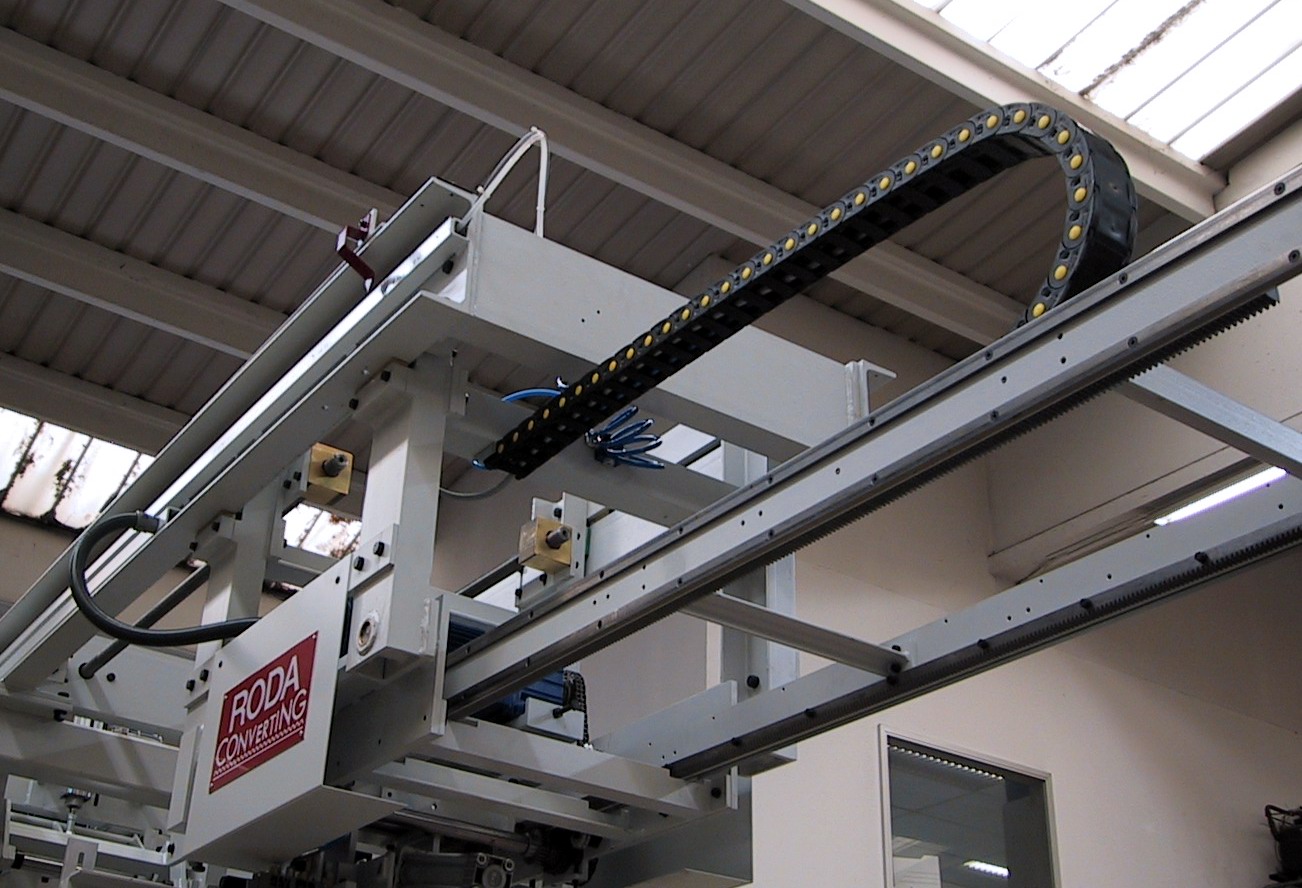
The cable carrier — also known as an articulated drag chain, energy chain, movable cable tray or cable track — is the component responsible for protecting, organizing and ensuring a long service life for the electrical cables, pneumatic hoses and hydraulic tubing that follow the movement of a machine, piece of equipment or robot. A CNC lathe in a machine shop, an industrial robot on an assembly line, a portainer at a port or a passenger boarding bridge (finger) at an airport: each application requires its own technical specification, with dimensions suited to withstand millions of cycles without failure. Getting the specification wrong means cables that come loose, chafe, break or jam the equipment's movement — with downtime costs far higher than the cost of the cable carrier itself.
The Measurements You Need to Gather
Before requesting a quote, gather the exact measurements of the set of cables, hoses and tubing that will run through the cable carrier:
- Internal and external height needed to accommodate cables and hoses without excessive friction;
- Internal and external width of the cable carrier channel;
- Minimum bend radius required by the available space at the installation and the range of motion;
- Total length of the travel path (moving section + fixed section, when applicable).
These four pieces of information — height x width (internal/external), bend radius and total length — are the basis of any precise technical quote.
Nylon or Steel: Which to Choose?
Besides the measurements, it is essential to specify whether the cable carrier should be metallic (steel) or plastic (nylon). Nylon cable carriers are lighter and quieter, suited for machinery, robots and continuous-motion equipment in less aggressive environments. Steel cable carriers, in turn, serve heavy-duty applications such as ports, cranes, overhead cranes and environments with high mechanical or thermal demands, or a heavier load of cables and hoses. The choice of material directly impacts durability, noise, weight on the moving structure and project cost.
Typical Applications
Our Brevetti Stendalto cable carriers — BERUF's partner in the Brazilian market for over 20 years — serve everything from the simplest to the most complex project: CNC machines, industrial robots and cobots (including with robotic anaconda, the retractable cable box for articulated arms), cranes and overhead cranes at ports, and boarding bridges (fingers) at airports. Each application defines not only the measurements, but also the material and the appropriate mounting accessories.
Summary: What to Send for a Quote
- Internal and external height x width;
- Bend radius;
- Total length of the travel path;
- Desired material (nylon or steel), if already defined;
- Application and environment of use (machine, robot, port, overhead crane, etc.).
With this information in hand, our technical team can recommend the ideal cable carrier — in nylon or steel, manufactured by Brevetti Stendalto — for your project.
To see the available options, check out our cable carrier line.
Ready to Quote Your Cable Carrier?
Send your project measurements and receive specialized technical support on WhatsApp.
Chat on WhatsApp